Introduction
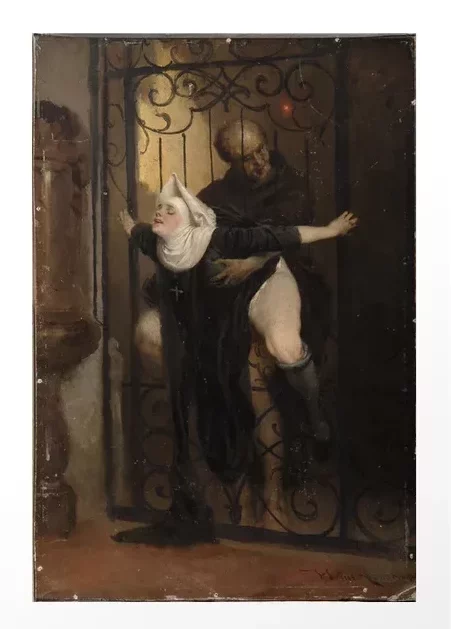
The Sin (Die Versündigung) is an 1880 painting by Heinrich Lossow. It shows a monk and a nun in a sexual encounter across a screen. The architecture separates the figures while creating the opening through which they meet. The title and their religious clothing are the clearest cues for reading the image.
The work is often discussed alongside the alleged Banquet of Chestnuts of 1501. The painting itself contains no banquet or identifying portrait of a Borgia. The story is useful as context for its later interpretation, with a distinction between the documented work and the event it is sometimes said to depict.
See the Art Renewal Center catalogue for the work and its date.
Quick Facts: The Sin by Heinrich Lossow
Created: 1880
Artist: Heinrich Lossow (1843-1897)
Subject: The Banquet of Chestnut, alleged 1501 Vatican orgy
Historical Source: Johann Burchard's diary (sole account)
Current Location: Current public display location unconfirmed
Controversy Level: Condemned by Church, critics, and public
Historical Accuracy: Disputed by modern scholars
The Banquet of Chestnut: History or Propaganda?
On October 30, 1501, according to a single historical source, something extraordinary happened in the Vatican. Johann Burchard, the Pope's master of ceremonies, wrote in his Latin diary about an event so shocking it still makes historians uncomfortable five centuries later.
Burchard claimed that Cesare Borgia hosted a dinner party in his Vatican apartments with fifty courtesans as entertainment. These women danced clothed, then naked. Candelabras were removed from tables and placed on the floor, chestnuts scattered around them. The courtesans crawled on hands and knees, naked, collecting chestnuts with their mouths while Pope Alexander VI, his daughter Lucrezia Borgia, and Cesare watched. Then things got worse. Prizes were awarded to guests who managed to have sex with the courtesans the most times.
If you're thinking "that sounds completely insane"—yes, exactly. Which is why historians have been arguing about its truth for centuries.
Did the Banquet of Chestnut Really Happen?
Here's what we know for certain: Johann Burchard existed. He really was the Vatican's master of ceremonies. His diary is real and still exists. That specific entry is actually in there—it's not later fabrication or forgery.
But here's what makes historians skeptical: Burchard was the only person who wrote about it. Not a single other contemporary source mentions this event. Nothing. In an era when Rome was full of ambassadors, spies, gossip-mongers, and people who'd love to damage the Borgias' reputation, only one person thought to record history's most outrageous papal party.
That seems suspicious. Events this scandalous don't usually stay secret except for one diarist. Either it didn't happen, or it happened very differently than described, or Burchard exaggerated something he heard secondhand, or—and this is what many historians suspect—he wrote it down specifically to create damaging propaganda against a family with plenty of real enemies.
The Borgias were genuinely corrupt. Pope Alexander VI absolutely had illegitimate children, used his position for personal gain, and lived far from Christian ideals. Cesare Borgia was a legitimate monster—ruthless, possibly a murderer, definitely amoral. These weren't good people being unfairly slandered.
But being corrupt doesn't mean every crazy story about you is true. The Borgias had enemies who would happily invent or embellish scandals. The question isn't whether they were capable of such an event—they probably were—but whether it actually occurred as described.
Why Lossow Painted the Controversial Scene
Lossow used close observation of dress and setting in his genre scenes. Here the screen and the habits do most of the storytelling. The image plays on the contrast between the religious roles of the figures and what they are doing. Lossow’s intention is not established by the surviving image.
The Immediate Outrage and Condemnation
The religious setting gives the picture its provocative force. The surviving catalogue identifies the work and dates it to 1880. It provides no record of a first exhibition, censorship decision or formal Church condemnation.
Where Is "The Sin" Painting Today?
The catalogued image is available online. A current public display location and a continuous ownership history have not been established here. Treat a digital reproduction as evidence for the composition, with provenance requiring a separate record.
The Technical Mastery Behind the Scandal
Here's something that gets lost in all the scandal and moral outrage: Lossow could really paint. Whatever you think about his choice of subject for "The Sin," the painting demonstrates serious technical skill.
His handling of light and shadow created atmospheric depth. The composition directed viewer attention exactly where he wanted it. The figure work showed solid academic training—accurate anatomy, convincing poses, believable human forms. The rendering of fabrics, flesh tones, and architectural details all displayed the kind of painterly competence that only comes from rigorous training and practice.
In some ways, this made the painting more problematic. If it had been technically crude, critics could dismiss it as mere pornographic trash. But Lossow's skill meant confronting the fact that a genuinely talented artist had chosen to use his abilities for scandalous purposes. That felt more threatening than simple obscenity—it was obscenity elevated to art, which seemed to make it worse.
What "The Sin" Means Beyond the Scandal
Strip away the sex and shock from "The Sin," and Lossow's painting is actually about power and corruption. The Banquet of Chestnut story endures not because people enjoy thinking about chestnuts and nakedness, but because it crystallizes a larger truth: institutions that claim moral authority don't always live up to their stated values.
This was especially resonant in the 19th century. Europe was grappling with church authority, the legacy of religious wars, the relationship between faith and reason. Lossow's painting participated in these debates by showing the church at its historical worst—corrupt leadership using spiritual authority for personal pleasure while preaching morality to everyone else.
The painting asked uncomfortable questions. If the pope himself participated in such events, what does that say about claims to moral leadership? If those closest to God behaved this way, what does that mean for faith itself? Can institutions be holy when their leaders are profane?
These weren't abstract theological questions. They touched on real political and social issues about church power, religious hypocrisy, and whether traditional authorities deserved continued deference or should be challenged and reformed.
Modern Perspectives on Lossow's Painting
Contemporary viewers bring different perspectives to "The Sin" today. We're simultaneously less shocked by sexual content than Victorian audiences were, yet more critical of how the painting depicts women. Those courtesans are objects in Lossow's composition—they exist for male pleasure and viewer titillation, not as full human beings with their own agency or interiority.
We're also more skeptical about historical accuracy. Modern historical method makes us question single-source stories, especially ones this conveniently scandalous. We understand propaganda and how political enemies use sex scandals to destroy reputations. We're less likely to accept Burchard's account at face value.
Yet there's something compelling about the painting's willingness to depict power's corruption. In an era when powerful men continue to be exposed for sexual misconduct, when institutions protect abusers, when authority figures preach morality while practicing exploitation—Lossow's subject matter feels uncomfortably relevant. The specific details might be different, but the pattern of powerful people behaving badly while maintaining public respectability remains depressingly familiar.
Frequently Asked Questions About "The Sin"
What does "The Sin" painting show?
The painting depicts an intimate encounter between two religious figures across a screen. The association with the alleged Banquet of Chestnuts is an interpretation of the work.
Did the Banquet of Chestnut really happen?
Historians are skeptical. Only one source—Johann Burchard's diary—documents the event, despite Rome being full of people who would have loved to spread such scandalous news. The Borgias were genuinely corrupt, but this specific event was likely exaggerated propaganda or complete fabrication.
Why was Lossow's painting so controversial?
In "The Sin," Lossow painted explicit sexual acts involving a Pope and cardinal, which was considered blasphemous by the Catholic Church and obscene by many critics. The painting combined religious figures with pornographic content, crossing moral boundaries that 19th-century society found unacceptable.
Where is "The Sin" painting located now?
The work is catalogued online. A current public display location is unconfirmed.
Are there photographs of "The Sin" painting?
Historical documentation of the painting exists in art archives and publications, though high-quality public images are limited due to its controversial nature and private ownership. Some reproductions circulate in academic contexts.
What other controversial paintings did Lossow create?
Lossow painted several erotic works throughout his career, exploring historical and mythological themes with sexual content. "The Sin" remains Lossow's most notorious work, but he created other paintings that pushed boundaries of acceptable subject matter for academic artists.
Conclusion: A Scandal That Won't Die
Start with what the painting shows, then compare the reading with the catalogue and the separate account of the 1501 banquet. The distinction matters whenever a historical story is used to identify the subject of an image.
Related Articles
The Enchantress by Heinrich Lossow: When Poetry Becomes Dangerous
Marie Antoinette and Marie Thérèse at Versailles by Heinrich Lossow
Last Updated: November 23, 2025